


You are buying for someone who is away more than they are home, and they already own everything you can think of. That part is familiar. The catch is that their pockets are fully let, and anything new has to evict something.
Travel gift lists ignore this. They are written for the checkout page, where a thing only has to sound useful for 4 seconds, and a pocket is a stricter landlord than a checkout page. The folding luggage scale, the adapter that fits every socket except the one in the hotel, the pillow with a hood: all of them sound like travel, and most of them come home unused, in the same drawer as last year's. The pattern is not unique to travel, as we found when we looked at how often a well-meant gift ends up binned.
So this guide judges gifts the way a traveller judges them without noticing: at the ticket barrier, with a queue behind and a bag on one shoulder. Three tests, each one you can run in a shop in under a minute, and none of them appears on a product page. We sell some of the things that pass, which you should weigh, and we will say where something we do not sell wins.
The queue where a wallet works hardest
A frequent flyer takes their wallet out in public more than almost anyone. Security, the gate, the airport train, the hotel desk, the tap at the station on the way home. Each time it is open, visible and held in one hand while the other hand does something else.
The checkpoint has also become particular about what comes out. The TSA expected to screen more than 18.5 million people over the July 4 2025 holiday, and reported that nearly 94% of passengers were presenting a REAL ID or another acceptable form of ID, such as a passport, since enforcement began on 7 May 2025 (TSA). That is a specific document, found, shown and put away, with a hall full of other people doing the same.
The crowd is the point for anyone else watching it. A pair of pickpockets pleaded guilty in 2018 to taking more than £40,000 from travellers at Heathrow and Luton airports, and police noted that they deliberately worked transport hubs because people there are off guard (The Points Guy). A gift for a traveller earns its place in exactly that queue or it does not earn it at all. How to carry yourself in those places is a subject of its own, and this article sticks to the object in the hand.
Test 1: it comes out and goes back with one hand
Stand in a shop with your bag on your shoulder and your phone in your other hand. Now get a card out of the gift and put it back. If you had to set anything down, the traveller will too, and they will do it on a conveyor belt with a stranger close behind.
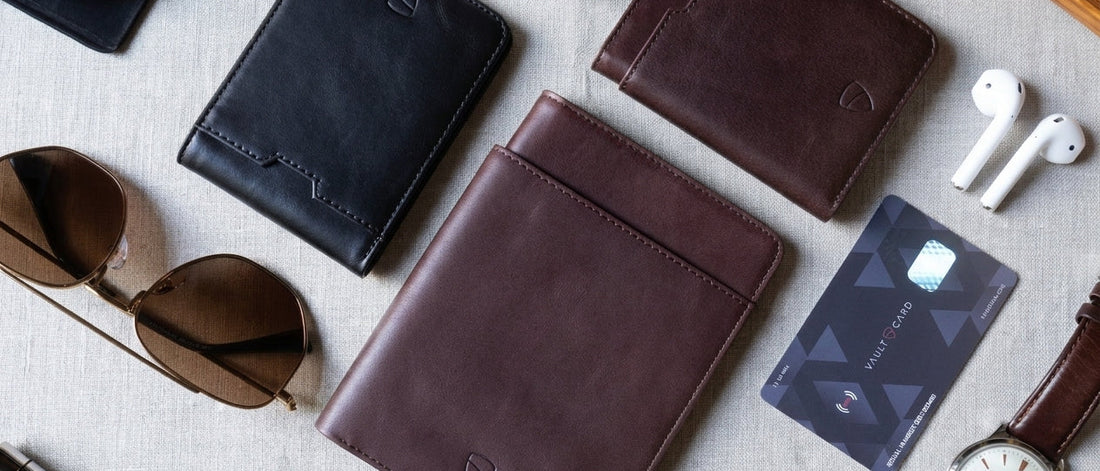
A passport holder faces the hardest version of this test. It has to present the photo page flat for the officer, carry the cards that follow the passport through the airport, and close again without a fastening to hunt for. Our KENSINGTON is built for that sequence: the passport, space for 8 cards and notes flat in the bill compartment, in one piece that opens like a book and shuts the same way.
The pass or fail is physical, not a matter of taste. A zip-around wallet is the right answer for the person who wants coins, keys and cards in one place, and the wrong one for the person who is at a checkpoint twice a week. Buy for the second person and you have bought for the queue.
Buying the London one for someone who lives in Chicago is the most common way a good wallet becomes a drawer wallet.
Test 2: their money fits without a fold they did not choose
Banknotes are not one size. A US dollar bill is a different shape from a £10 note or a €20, and a bifold cut for one will either fold the other against its will or refuse it altogether. This is the test most gift buyers never run, because the wallet arrives empty and looks fine empty.
So ask where the person spends before you ask what colour. Our MANHATTAN measures 104 x 76 x 10 mm, weighs 39 g, and takes US dollar notes flat and unfolded, along with Canadian, Australian and Japanese notes. Pound and euro notes do not fit it. Our CITY is the mirror image at 77 x 98 x 10 mm and 38 g: pounds and euros flat, and a dollar bill does not fit. Buying the London one for someone who lives in Chicago is the most common way a good wallet becomes a drawer wallet.
If the person changes currency every week, the question answers itself. A cardholder that takes folded notes, or a wallet with a single fold for cash, is indifferent to which country printed them.
Test 3: it blocks RFID reads without being asked
Card fraud is rising again in the UK and across Europe, the end of the journey many frequent flyers make most often. UK card fraud cases rose 15% in 2024, reversing several years of decline (UK Finance), unauthorised card losses reached £572.6 million, about US$773 million (FinTech Magazine), and card fraud losses across Europe hit a record €1.69 billion in 2025 while UK losses edged up to £594.9 million (CFOtech). Those totals count every way a card's details leave its owner, and most of the 2024 rise was remote purchase fraud, which happens online. The narrower point for a gift buyer is that card details travel, and a crowded queue is one of the places they can be read.
The mechanism is ordinary radio. A contactless card follows the ISO/IEC 14443 standard and talks to a reader at 13.56 MHz, a short-range band used for contactless identification and payment (ISO/IEC 14443). A portable reader hidden in a bag, backpack or glove can skim a card after a few seconds of standing close, in a queue or on public transport, without ever touching the wallet (ISACA), and most modern Android phones carry a built-in NFC reader that can scan a contactless card's data with no extra hardware (RFID skimming).
A shielded wallet blocks RFID reads at close range. That is the whole claim, and the useful part is that it asks nothing of the owner, who is busy finding a passport. It is quiet engineering rather than a promise about fraud, and the full case for it is laid out on our evidence page, so this article will not re-run it. The checkable part in a shop is simpler: ask whether the lining is shielded, and if the answer is a shrug, the test is failed.
Where the gift list wins and loses
A neck pouch worn under a shirt wins for someone sleeping in hostel dorms, and we do not sell one. A lanyard badge holder wins for cabin crew who show the same pass 40 times a day. Packing cubes win for almost everyone, but they live in a suitcase rather than a pocket, so they never compete for the space this article is about.
For the person who taps through gates and barriers all day, the real choice is a cardholder or a wallet, and that comes down to how many cards they actually use between flights. Our MOORGATE weighs 20 g and holds cards with folded notes of any currency, which makes it the lightest thing in this article and the quickest through Test 1. It is a cardholder rather than a shielded wallet, so the traveller who wants Test 3 as well slides a VAULTCARD into 1 slot: the card draws power from the scanner's own field, needs no battery, and jams readers within 4 cm of it.
A phone case with card slots is the right gift for the person who never hands their phone over and never lets the battery die. The frequent flyer is usually holding that phone in the other hand at the barrier, which is why the two tend to travel separately.
Verdict: buy for their barrier, not your idea of it
The honest answer to the opening question is that a frequent flyer does not need another thing. They need one of the 2 or 3 things already in their hand to do its job better in a queue, and the gift that gets kept is the one they have stopped noticing by the second trip. Ask where they spend, watch which hand holds the phone, and buy for that moment rather than for the photograph.
Everything we make lists the notes it takes, which is where this decision starts. The full range, sorted by that first, is in our RFID wallets collection.