


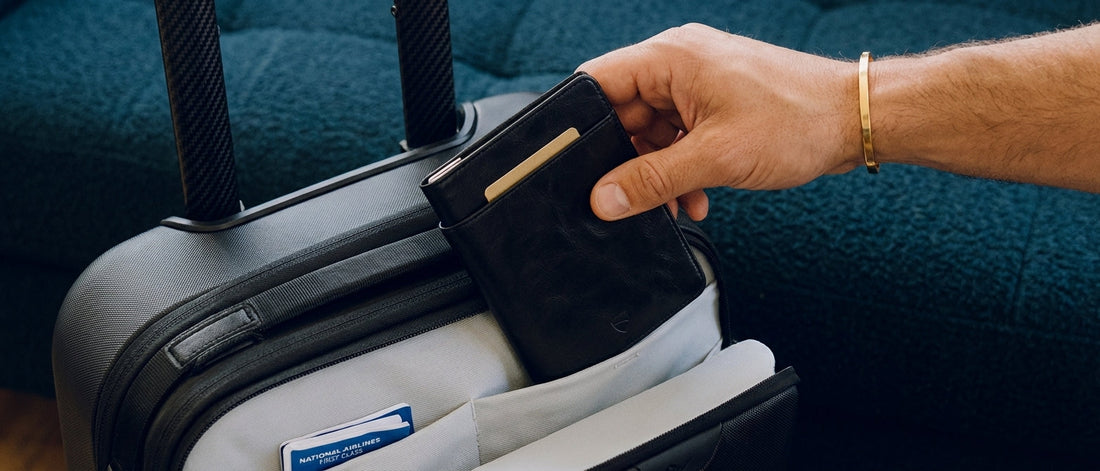
The wallet on the hall table goes into a pocket on the way to the airport, chosen because it happened to be within reach, carrying every card you own and a folded receipt from March. That is the travel security decision you will make this year without realising it was a decision. Not the hotel safe. Not the insurance.
That choice gets tested on day 2, in a queue, with a bag on one shoulder and a map open on your phone. Nobody is alert while reading a map.
The standard advice splits badly. Half of it is "stay vigilant in crowds", which is not an instruction, it is a mood. The other half is a fabric pouch worn under your shirt, which works beautifully right up to the moment you have to reach into your waistband at a café till.
Around 2,000 Americans report a passport lost or stolen in Paris every year, and many of them are victims of pickpockets working the museums, the crowded metro and the train stations, according to the U.S. Embassy in France. That is one city. What follows is not a list of things to be frightened of. It is a set of checks you can run on your own pockets in the next 2 minutes, before you book anything. Both halves of this crime, the hand and the card reader, are decided by the same thing: how close a stranger can get to your pocket, and for how long.
Paris first, then everywhere else
The pattern is not French. The U.S. State Department's travel advisory for France states that pickpocketing and phone thefts are common, especially in crowded places.
Read that line next to the Paris numbers and the geography drops away. What is left is a set of conditions: crowds, luggage, a barrier or a staircase, and a few seconds of divided attention. A ticket gate is a machine for making a stranger stand very close to you while you look down at your hands.
That is useful, because conditions can be planned for and cities cannot. You are not avoiding Paris or Rome. You are avoiding 20 seconds of standing still in a press of people with an open bag.
A pickpocket is a reach, not a plot
Stand up right now with your wallet in your back pocket. You can feel exactly where it sits. So can the person behind you on an escalator, and they have the better angle.
Most of the in-person defence is placement, and it costs nothing:
- Front trouser pocket, or an inside jacket pocket that zips or buttons. Outside coat pockets are display cases.
- Bag worn across the body, opening against your ribs rather than swinging on your hip.
- Cards split in two places. What you carry for the day, and what stays in the room.
- Phone in a hand or a front pocket, never in the back one, and never face up on a café table.
The distraction is the tell. A spilled drink, a folded map or newspaper pressed against your chest, a clipboard, a handful of coins dropped at your feet. Anything that arrives suddenly and asks for your eyes is worth a second of suspicion. The rule is simple and slightly rude: when something unexpected touches you, put a hand on your bag before you look at the thing.
Both halves of this crime, the hand and the card reader, are decided by the same thing: how close a stranger can get to your pocket, and for how long.
The second reach is 10 cm
The other half of the problem happens without anyone touching you at all. Contactless cards are built to answer at short range. The ISO/IEC 14443 proximity-card standard, used for the overwhelming majority of contactless deployments worldwide, targets an operating range of up to 10 cm. That short reach is the entire design, and it is why a tap is quicker than finding a coin.
Cards that answer readers are now the norm rather than the exception. The UK has passed 160 million contactless cards in issue, with contactless accounting for 76% of all debit card transactions made in June 2026.
Researchers have built the demonstration rather than just described it. At the CISPA Helmholtz Center for Information Security, a "Digital Pickpocket" demonstrator shows that it is possible for criminals to obtain secrets and money without physically stealing a card, and it is used to teach children and adults how to protect themselves against wireless data theft.
A shielded wallet does one narrow, physical thing about that route: it blocks wireless card reading at close range, so a reader held near your pocket gets no answer. It does not stop fraud in general, and anyone who tells you it does is selling something badly. If you want the testing rather than the assertion, we have set out the evidence on whether RFID wallets actually work separately.
Three checks before you buy anything
Count what you are protecting. Open your wallet and count the cards. Now count the ones you could use in another country. For most people the second number is 3 or 4. Everything above that is bulk you will carry through 6 airports for no reason, and bulk is what pushes a wallet from the front pocket to the back one.
The front pocket test. Sit down with the wallet in the front pocket of the trousers you will actually wear on the trip. If it digs in, you will move it, and you will move it to exactly the pocket a thief prefers. A wallet that only works standing up has failed.
Mechanism, not promises. Read what the maker claims. "Blocks wireless card reading at close range" describes something physical that can be tested. "Keeps your money safe" describes nothing at all. The first is a specification. The second is a mood, and we are back where we started.
What works, including the things we do not sell
The hotel room safe beats every product on this page for one item. A passport you are not carrying cannot be lifted from a museum queue, and once you have checked in, most days do not require it. Photograph the data page, leave the book behind, carry a driving licence or a copy.
An internal jacket pocket that zips is free and, in a cold city, close to unbeatable. A money belt genuinely works, and it also gets abandoned around day 3 by most people who pack one, which is a design flaw disguised as discipline. Loose RFID sleeves work while you use them and then live in a drawer.
If the wallet you already own is the one you want to keep, there is a smaller move than replacing it. The VAULTCARD sits among your cards, draws power from the scanner's own field so it needs no battery, and emits an electromagnetic jamming signal that blocks readers from reading any RFID card within 4 cm of it. It is also the answer for cards kept loose in a bag rather than in a shielded case.
The thing that survives a trip is the thing you were carrying anyway. That is the honest case for a shielded wallet: not that it is cleverer than a safe, but that it is with you at the ticket barrier where the safe is not. Ours is built to the same logic, which is why the CHELSEA slim RFID-blocking wallet holds 4 to 8 cards rather than 12. The card limit is the security feature.
What we would take, and when
We make wallets, so weigh this accordingly. For travel days, the moving days with a boarding pass and a border, the piece that earns its place is the KENSINGTON RFID passport holder, which takes a passport plus 8 cards and keeps the whole set in one hand in an inside jacket pocket, shielded against close-range reads.
It is the wrong choice for a Tuesday at the Uffizi. On those days the passport stays in the safe and a slim card wallet in the front pocket is the better carry: less to lose, less to fumble, nothing to put down on a counter. Two objects, two jobs, and neither of them a pouch worn under a shirt.
The verdict
Pickpocketing is not sophisticated and it is not mysterious. It is a reach, made possible by a crowd and a moment of looking at something else, and researchers have demonstrated that a contactless equivalent of that reach is possible without physically stealing a card, on cards whose standard is designed to answer a reader at up to 10 cm. Both are answered by the same unglamorous habits: fewer cards, a front pocket, a hand on the bag when something unexpected happens, and shielding built into the thing you already carry.
Get those right before you leave and the rest of the trip can be spent looking at the actual city. If you want close-range card reading handled by the wallet you already carry, our RFID-blocking wallet range blocks wireless card reading at close range.