


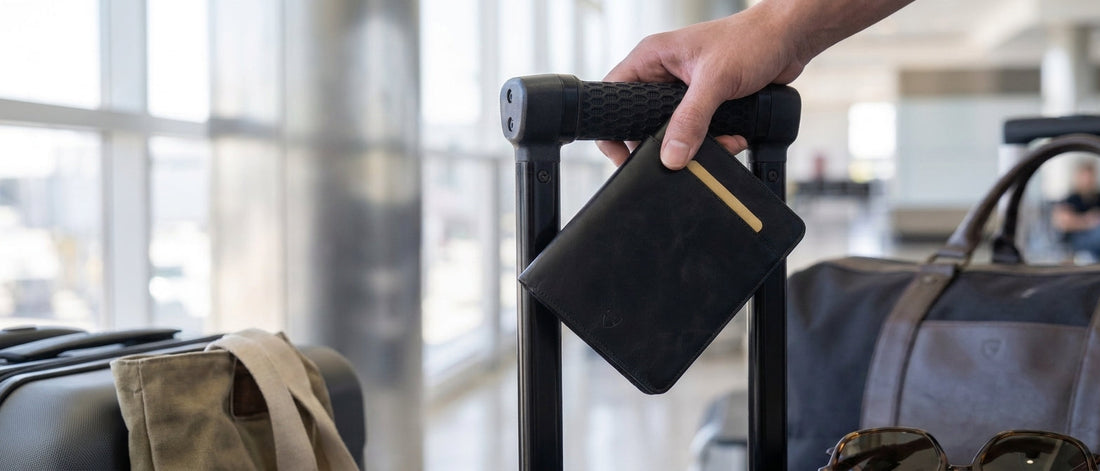
The wallet you bought for travelling was bought for the airport. You spend an afternoon in the airport and the rest of the trip somewhere else, and those are different places with different pockets. Only one of them asks to see your passport.
We make wallets and a passport holder, and we sell them, so read what follows as a position held by people with an interest in it. The position is this: a travel wallet is not a bigger wallet. It is a wallet that fits 3 measurements you cannot change and a climate you cannot control, and once it fits those, the slot count is a detail.
Almost none of this appears on a product page. The page gives you dimensions and a number of slots, but not how a passport goes in, not how your banknotes lie, and not what the lining is built to do about the field your cards use. Those are the things that decide if the wallet is still in your pocket on day 10 or in the hotel safe with the adaptor plugs, and every one of them can be checked in a minute with objects you already own.
The sizes a standard has already fixed for you
Take a bank card out and look at it edge on. Nearly every card you own, from the debit card to the driving licence, is cut to the same ISO/IEC 7810 ID-1 specification, 85.60 by 53.98 mm and between 0.68 and 0.84 mm thick. The card is not a variable. Only the slot is.
That matters because slot depth is a choice the maker made on your behalf. A slot cut shallow shows the top third of the card, which photographs well and puts the printed digits above the leather in a crowded queue. A slot cut deep hides them and costs you a fingernail to get the card out. There is no right answer, but there is a wrong one, which is a slot so loose that the card slides when you turn the wallet over.
The thickness is the part people forget. Stack 4 cards and the arithmetic comes to roughly 3 mm of plastic, about a pound coin's worth, or 2 quarters stacked. Stack 8 and you are at 6 mm before a single layer of leather, which is why a cardholder rated for 8 cards is a different object from one rated for 4, however alike they look on screen.
Your passport is a booklet, and booklets have their own line in the same standard. ISO/IEC 7810 ID-3 sets them at 125 by 88 mm, so a passport pocket has a correct size and you can test for it in the shop. The passport should go in with the flat of your hand and come out with 2 fingers, with none of the cover's corners curling. A pocket cut to the booklet exactly feels precise on day 1 and has bent every corner by the end of the year.
Our KENSINGTON is the honest worked example: a passport holder with a shielded lining, 8 card slots and a bill compartment where notes lie flat, a passport holder first and a cardholder second. The passport also has a habit cards do not. It is handed over, at the desk, at the gate, at reception, and the holder is what it comes back into, rather than a jacket pocket where it sits loose until it does not.
The banknote is the measurement nobody prints
Cards are standardised. Passports are standardised. Money is not, and this is the measurement travel wallets most often get wrong, because the people choosing them check the slots and never check the notes.
Our own range makes the point for us. The CITY bifold takes pounds and euros flat and unfolded, and dollars do not fit it. The MANHATTAN takes dollars flat, along with Canadian, Australian and Japanese notes, and pounds and euros do not fit it. Both are 10 mm thick and within 1 g of each other, and they are different wallets for one reason, which is the paper that goes in them.
So the question for a bifold is not where you live. It is what will be inside it when you land. A MANHATTAN that fits your life in Boston will not take flat the £20 notes a Heathrow cash machine gives you, and a CITY that is right for London is wrong for the fortnight in Chicago. A bifold is a single-currency object, and it is better to know that in the shop than at the first till.
For anyone whose trips cross between dollar and pound or euro economies, the folded-note designs are currency-agnostic. The CHELSEA takes 4 to 8 cards and 1 banknote folded, the MOORGATE weighs 20 g, the BRIXTON adds an ID window and the BROMPTON holds the fold in a metal clip. The 2 zip wallets, the MAYFAIR and the NOTTING HILL, take notes half-folded in any currency, and the NOTTING HILL has a coin pocket, which matters more abroad than at home. A country that still hands you coins in change will fill a trouser pocket by Tuesday.
Cards are the same size everywhere, passports are the same size almost everywhere, and money is the one thing that is not.
The shield has a range to fit as well
The third thing a travel wallet fits is invisible. Contactless cards built to the ISO/IEC 14443 standard talk to a reader at 13.56 MHz, and a reader built to that standard has an activation field of about 4 inches, roughly 10 cm. That is the range a shielded lining is built around, and it is a short one. The card has to be close to be read at all.
What does the work is a layer, not the hide. Metals such as aluminium and copper block the signal by reflecting it, the principle behind a Faraday cage, and ferrite materials block it by absorbing the energy instead. Either way the lining blocks reads of the cards inside it at close range while the wallet is closed. It does nothing for the card in your hand at the till, and it is not meant to.
Whether that is worth having at all is a question we have answered at length on its own page, with the evidence laid out rather than asserted, so we will not re-argue it here. The travel-specific point is simpler. A shield that works blocks the cards you want read as well as the ones you do not, so the hotel key and the metro pass have the same relationship to the lining as your bank card, and a wallet that fits a traveller allows for that.
You cannot see the layer, so read the construction rather than judging by the leather, because the materials that do the shielding are metals and ferrite and the hide is not among them. There is also a version of the shield that travels loose. Our VAULTCARD is a card-sized jammer powered by the reader's own field, with no battery, that senses a reader and emits a jamming signal blocking any RFID card within 4 cm of it from being read, which puts a shield into a wallet with no lining at all.
The climate your wallet flies through
Leather is a hide, and a hide answers to the weather it is left in. Cold is the surprise. At low temperatures the moisture and natural lubricants inside the leather freeze and crystallise, and the fibres go brittle and fracture under sudden stress. The wallet that spent the night in a car at a ski resort and was then bent open at breakfast is where that sentence turns into a crack along the fold.
Heat works the other way. High heat and direct sun draw the fats and oils out of the hide, leaving it dry and stiff, and over time the dryness shows as fine lines and then cracks. The dashboard of a hire car in July does this, and so does a sun lounger, and so does the hotel windowsill where the wallet was put down with the keys.
Humidity is the slow one. In damp air leather grows mould and mildew, which discolour it and weaken the material, and the damp a wallet picks up on a wet day in a humid city is sealed in rather than released when it is zipped into a plastic bag or a packed case overnight. The instinct at this point is to reach for a conditioner on the hotel bathroom shelf, and we have written at length about why that instinct is usually the wrong first move.
The common thread is that none of these three things happens to a wallet in a pocket. All of them happen to a wallet that has been put down somewhere, in a car, on a lounger, in a case, and left to take whatever temperature the place was running at. Leather has been coping with the temperature of a body since it was skin.
Where the argument runs out
A thesis about airports and cities does not cover everyone. The traveller who checks into a different hotel every 2 nights has a passport that comes out at every front desk, and for them the passport holder is the daily wallet and the slim one is the spare. Their city is a series of reception counters, and the airport object is the right one all week.
The traveller who crosses borders on an ID card never needs the ID-3 pocket at all. Their ID is the same 85.60 by 53.98 mm as their bank card, and a travel wallet, for them, is just a wallet whose notes fit the destination. Nothing above changes except that the passport section is somebody else's problem.
The traveller who pays by phone everywhere and wants only an ID and 1 backup card is asking a cardholder question rather than a travel wallet question, and we have set out the 3 checks that answer it with your own cards. And a reasonable person can land elsewhere on the single-currency bifold. If you fly to one place twice a year and live the rest of your life at home, the bifold that fits home money is the right wallet, and the destination currency rides in a jacket pocket for 10 days.
Before you fly
The evening before a flight, this is the whole job, and each item is done once.
- Lay the notes you will actually be spending against the wallet you plan to take. If they only lie flat folded, take a folded-note design and stop arguing with the leather.
- Move the hotel key and the transit pass to the pocket your hand goes to at the gate, rather than leaving them inside the shielded wallet.
- Take out the cards that only work at home. The gym pass and the supermarket loyalty cards stay on the hall table, and the slot count you need abroad drops with them.
- Keep the wallet on your body for the flight, not in a bag you will not see for hours.
- Give the wallet air after a wet day. Leave it open on a dry surface overnight rather than sealing the damp in with the packing.
- Leave the conditioner at home. A fortnight is not long enough to need it, and a hotel bathroom is the wrong place to find out.
The verdict: fit the note first
Cards are the same size everywhere, passports are the same size almost everywhere, and money is the one thing that is not. That is why the slot count is the last thing to look at rather than the first, and why a wallet that is perfect at home can be wrong by the time the plane doors open.
So the rule of thumb is this. If the notes you will spend fit the wallet as it was built, flat or folded, if the passport goes in without curling a corner, and if the thing stays on you rather than on a dashboard, you have a travel wallet. Everything else is leather, and leather can be looked after.