


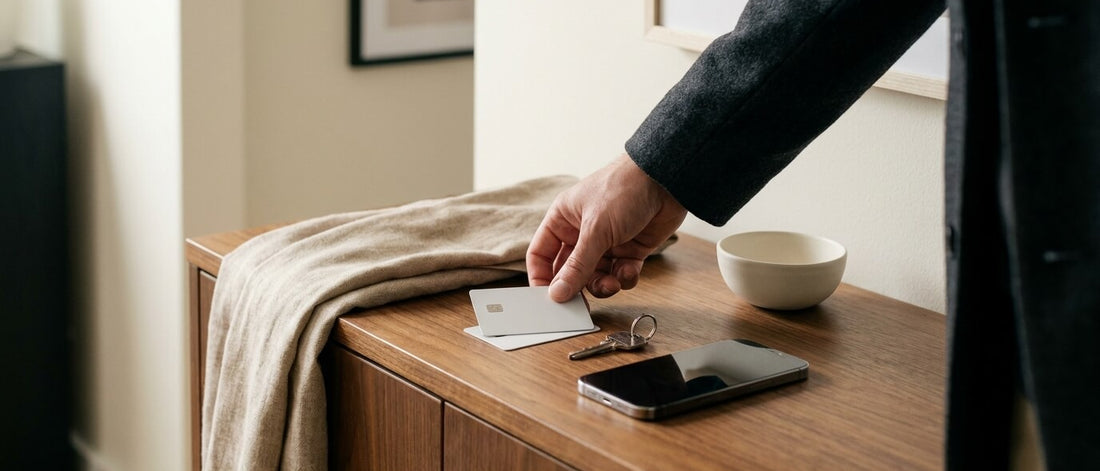
There was a time when a wallet's job was to hold everything: cash, loyalty cards, receipts you meant to file, a photo of someone you loved. That wallet is dying, slowly and without much fuss. Wallets have been shrinking for centuries as people carry fewer physical items, according to wallet-carrying research from Boston University, and the last decade of digital payments has simply accelerated a trend already under way.
The Wallet Got Thinner Because Life Did
Most Americans still carry four credit cards, though financial advisers suggest two or three is plenty, per the same Boston University analysis. That gap between habit and advice is where the minimalist wallet lives. It is not asking you to give anything up. It is asking you to admit that the loyalty card for a shop you visited once in 2019 does not need a permanent home in your pocket.
In many markets, carrying cash seems to have become optional for a lot of people day to day, at least for routine spending. What is left in a modern wallet is a tight set of essentials: two or three cards, an ID, perhaps a note or two for the places that still insist on it. A wallet built for that reality does not need eight card slots and a coin purse. It needs to be slim, sturdy, and honest about what it actually holds.
The Numbers Behind the Shift
This is not a niche aesthetic preference. Global search interest in "slim wallet" held consistently high through the year to July 2025, a pattern that suggests sustained demand rather than a passing trend, according to Accio's market trend analysis. The broader leather wallet market, which includes minimalist styles alongside bifolds, purses and other formats, gives some sense of the category's overall scale: it was valued at USD 46,061.61 million in 2024 and is projected to reach USD 68,290.77 million by 2033, a compound annual growth rate of 4.5 percent, per Market Growth Reports. That figure does not isolate minimalist wallets specifically, but it points to a wallet market that is growing, not shrinking, even as cash use declines.
Industry analysis of the minimalist wallet category points to two forces doing the heavy lifting: premium materials and built-in technology, according to IndexBox. Full-grain leather and recycled ocean plastics are moving from niche to standard. RFID-blocking construction is following the same path, from optional extra to expected feature.
It is asking you to admit that the loyalty card for a shop you visited once in 2019 does not need a permanent home in your pocket.
Less Bulk, Better Materials
A thinner wallet only earns its place if it is well made. This is where the category has grown up. The industry shift toward full-grain leather and considered construction, noted by IndexBox, reflects a simple truth: when a wallet has fewer components, each one has to earn its place through quality, not quantity.
Our own approach follows the same logic. The MOORGATE minimalist cardholder weighs 20 grams and holds only what a modern wallet needs to hold. There is nowhere for it to hide bulk. Every seam and edge is visible, which means every seam and edge has to be right.
The Quiet Engineering Inside a Modern Slim Wallet
Slimming down a wallet does not mean stripping out protection, and this is where contactless technology matters. Contactless cards and passports communicate over short-range radio under the ISO/IEC 14443 standard, typically working within about 10 centimetres of a reader, a protocol maintained by ISO/IEC JTC 1/SC 17/WG 8 and documented in detail by RFID Label. That same convenience, tap and go, is what makes a card readable by any compatible scanner nearby, including a hidden one, without physical contact, as explained on Wikipedia.
An RFID-blocking wallet addresses this at the material level, working passively and without a battery: its metallic lining blocks and attenuates the radio signal between a nearby reader and the card, so the card cannot be powered up or read at the short ranges typical of skimming attempts, per the same source. It is not a gadget bolted onto a wallet. It is a lining, built into the leather, doing its job every time the wallet sits in a pocket or bag. Our RFID wallets collection is built around this principle: slim first, with a lining designed to block reader signals at typical skimming range, nothing for the owner to switch on or remember, though no lining is a substitute for ordinary care with lost or stolen cards.
Carrying Less, On Purpose
The minimalist wallet trend is really a decision about what deserves a place in your pocket. Fewer cards, no paper receipts, no coin purse for change you will spend at a self-checkout anyway: what remains gets carried with more intention.
For readers who want to go further still, some now carry a single active layer of protection instead of a full wallet lining. VAULTCARD sits among your cards and needs no battery: it senses a scanner's field and emits its own jamming signal, blocking readers from reading any RFID card within 4cm of it. It is the same underlying idea as a lined wallet, protection built in rather than considered separately, just applied to a slimmer carry.
A short list of what tends to disappear once someone moves to a minimalist wallet:
- Store loyalty cards that live on a phone app anyway
- Old receipts and ticket stubs
- A second or third card that stays untouched most days
- Bulk that serves no daily purpose, only habit
The Verdict: Carry Less, Carry Better
The minimalist wallet is not a trend in the fickle sense. It is what happens when payment habits, material standards, and manufacturing all move in the same direction at once, and the wallet finally catches up to how people actually live. Four cards become two or three. A battery-hungry gadget becomes a lining that works without asking for attention. A slab of leather becomes something that fits a front pocket without complaint.
If your current wallet has outgrown the way you actually use it, the CHELSEA RFID-blocking wallet is a reasonable place to start, slim enough to disappear into a jacket pocket, built to hold four to eight cards, with the protective lining already inside.