


The pockets you did not plan
Nobody chooses their everyday carry. It accumulates. The wallet arrived as a present, the keys came with the flat, and at least 1 card in the stack belongs to a shop that closed. Experian puts the typical American wallet at 3.7 active credit cards, down from 4.1 10 years ago, on its own numbers.
Then something forces a review. A new coat with shallower pockets. A trip where you need a passport, a boarding pass and both hands at once. Or the dull ache of sitting on a folded wallet for a 2-hour train journey.
That is the real decision, and it is smaller than the internet makes it sound: what earns a place in your pockets tomorrow morning, and what goes in the drawer. It is also more timely than it looks, because contactless accounted for 74% of all UK card transactions in 2024, according to UK Finance's annual fraud report, so almost every card in that pile now answers a reader wirelessly. Most people make the decision badly, because they make it while holding a nice-looking object in a shop.
Why the choice is harder than it looks
Functional style has a uniform now. Design coverage of 2024 and 2025 everyday carry gear identifies a durable, rugged "tactical" aesthetic, built on materials like anodised aluminium and reinforced textiles, as a leading trend shaping how people choose their kit. It is a good look. It is also the easiest thing in the category to fake, because ruggedness photographs and nothing else does.
Weight does not photograph. One-handed access does not photograph. Neither does the radio interface now sitting inside almost every card you own, which is where that 74% comes from and why it matters rather more than it used to.
Everything that decides whether an item is still in your pocket in 6 months can be tested in under a minute, with your own hands, in a shop, and none of it appears on a product page. That gap is not a conspiracy. It exists because the qualities that matter are cheap to get wrong and impossible to render in a hero shot. We make wallets, so read the last two sections as interested advice. The tests work just as well against us.
The radio layer is the one part of your everyday carry you cannot inspect, which is exactly why it gets oversold.
What the radio layer actually is
The contactless chip in your bank card is not magic and it is not Bluetooth. It works to ISO/IEC 14443, the international standard for proximity cards, which communicate with a reader over radio at 13.56 MHz. A card has no battery. The reader's own field wakes it up, and the card answers whatever is asking, because that is the entire point of tapping.
Skimming exploits exactly that obedience. The documented method is to hide a small NFC or RFID reader, inside a glove or a bag, for instance, and hold it close to a victim's contactless card to capture card data wirelessly, which can then be used for card-not-present fraud. Nothing needs to be taken out of your pocket, which is what makes it an everyday-carry problem rather than a banking one.
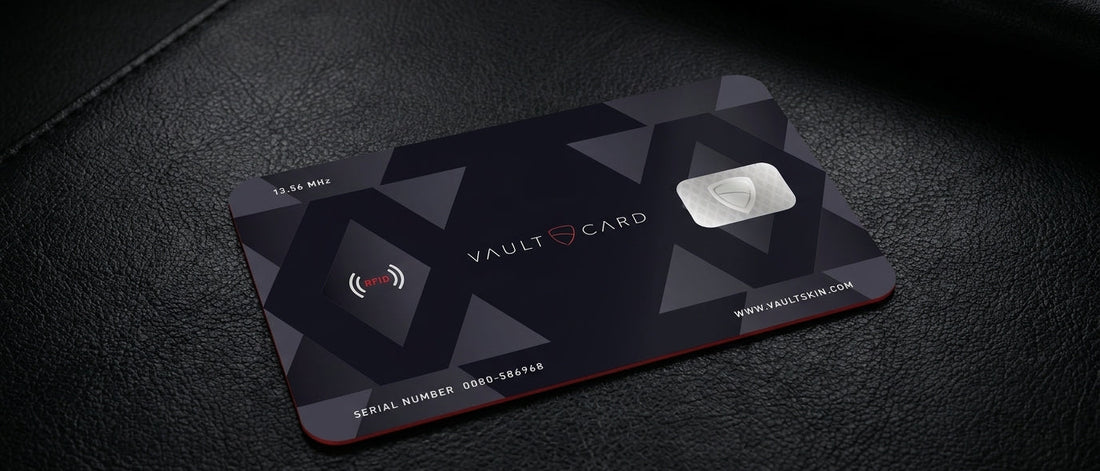
Shielded leather and jamming cards address that one mechanism: they interfere with a reader reaching your cards at close range. They do not touch anything else on the fraud map. The radio layer is the one part of your everyday carry you cannot inspect, which is exactly why it gets oversold. If you want the evidence rather than the adjectives, we set out the testing and the limits in our page on whether RFID wallets actually work, and a drop-in VAULTCARD is the honest option for anyone who likes their current wallet: powered by the scanner's own field, no battery, and it blocks readers from reading any RFID card within 4 cm of it.
Three tests you can run in under a minute
Forget specification sheets. Three checks separate gear that earns its pocket from gear that photographs well.
- The count. Empty your cards onto a table and sort them into the ones you used this month and the ones you did not. That 3.7 active cards is an average, not a target, and most first piles come out smaller than the stack they came from. Buy for the first pile, not the second, or you will carry a half-empty object that slouches and creases.
- The weight. Load the thing as you would actually load it, then hold it in an open palm. You notice weight for about a week and then you either stop noticing it or you stop carrying it. A MOORGATE minimalist cardholder weighs 20 g, which is less than a small bunch of keys. If a loaded wallet outweighs your keys, your jacket will tell you about it by Thursday.
- The reach. Stand up, put a cup in one hand, and get your travel card out with the other without looking down. If that takes two hands or two attempts, you will start carrying the card loose in a pocket within a fortnight, and a loose card is the one thing every item on this list was meant to prevent.
Notice that none of those tests involve a brand. They involve you, standing in a shop, doing the thing you will do 3,000 times a year.
Where the honest answer is not a wallet
Card fraud is large and it is not going away. Criminals stole £1.17 billion through unauthorised and authorised fraud in the UK in 2024, broadly unchanged from the year before, UK Finance reported.
That total covers a wide map: transfers talked out of people by phone, details harvested from data breaches, hardware planted on shop terminals. A New York case involved skimming devices fitted to card-swipe terminals in Manhattan supermarkets, which were used to clone cards and withdraw money from victims' accounts at cash machines, as CBS New York reported. That is physical hardware on a shop's own terminal, not a wireless read from a pocket, and no wallet on earth does anything about it. In the United States, credit card fraud was the most-reported form of identity theft in 2024, with over 450,000 reports, and financial fraud made up more than 40% of all identity-theft cases, on Security.org's figures, which is an argument for doing the free things today: turn on transaction alerts, use a virtual card number for one-off online purchases, and spend 2 minutes reading your statement, because those cover ground no leather can reach.
The things that do work on that scale are banks and card issuers, which prevented £1.45 billion of unauthorised fraud through their security systems in 2024, equivalent to 67p of every £1 criminals attempted to take, in the same UK Finance report. Your own kit is responsible for a much narrower job. If you carry 12 cards for work, a 12-slot bifold is the right object and a minimalist cardholder is vanity. Buy the tool, not the aesthetic.
What we would carry, and when
For most people the answer is one wallet sized to the real card count, shielded, with stitching that sits back from the edge rather than riding on it. A CHELSEA RFID-blocking wallet holds 4 to 8 cards, which is the honest range for someone whose table-sort produced a pile of 4 or 5, and the shielding is built into the wallet, so it blocks close-range wireless reading of the cards kept inside it.
If your sort produced 3 cards and you resent every gram, the argument runs the other way and the cardholder wins. If you already own a wallet you genuinely like, replacing it to gain shielding is the expensive route, and a jamming card slotted inside it is the cheap one.
And if your review was triggered by a trip rather than a coat, buy for the trip: a KENSINGTON passport holder is an RFID passport holder with space for 8 cards, so the passport and the cards travel as one object rather than loose in a bag.
The verdict
Everyday carry is not a collection. It is a shortlist, and the entry requirement is that the object makes tomorrow morning slightly easier without asking you to think about it. Ruggedness is a look. Weight, reach and a card count you have actually counted are the specification.
Run the three tests on whatever is in your pocket right now. If it fails on reach, it will keep failing. If it passes everything except the radio layer, our shielded wallets are where we would start, and you can hold the leather to the same standards you just held everything else.