


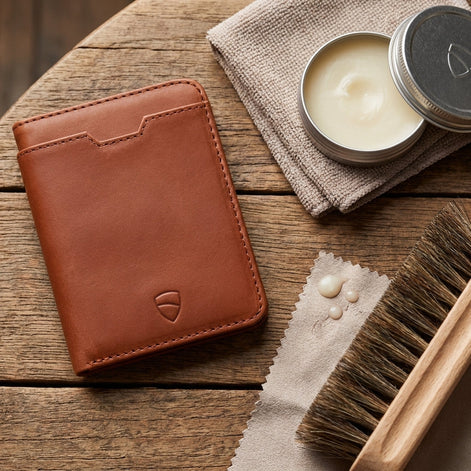
Press the spine of your wallet flat between finger and thumb and listen. If it creaks, something has already left it, and the bottle on your shelf is not going to put it back.
What left was water. Leather is a natural material that loses moisture over time, and the fibres that made it fold quietly for the first three years stiffen as they dry. The creak is the sound of a hide that has stopped moving as one thing and started moving as several.
So here is our position, and it is one a lot of care guides would argue with. Leather care is mostly storage and only slightly product. The conditioner gets the attention because it is the only part of the process anyone can sell you, and most people who ask us how to look after a wallet are applying three times as much as it needs, half as often as they think, to a wallet that is being ruined by a windowsill.
There is no shortage of language around leather now: hide origin, tannery, finish, grade. There is far less guidance on what any of it means in the hand, and almost none on the conditions the wallet then has to live in. We make leather goods for a living, so we have an obvious interest in you believing your wallet is worth keeping. We have no interest at all in you buying more conditioner. Everything below costs nothing except attention, and almost none of it appears on a product page, because the conditions that decide whether a wallet lasts ten years or four are impossible to photograph.
Where your wallet sleeps decides how long it lives
There is a fairly narrow band of air in which leather is happy. Conservation guidance for leather, hide and skin items puts it at a maximum of 25°C and 45 to 65% relative humidity, noting that below 40% the material loses moisture and becomes brittle, while above 70% it starts to attract mould. A long-term storage guide lands in much the same place, 60 to 70°F with humidity around 50 to 70%. Another puts the sweet spot at about 55% humidity at ordinary room temperature, wrapped in something breathable, because heat plus the wrong humidity will eventually dry-rot the hide.
Round all of that off and you get one range worth remembering: roughly 18 to 24°C, roughly half humidity, out of direct light. That is not a laboratory. That is a bedroom drawer.
Now think about where your wallet actually spends its off-duty hours. The shelf above the radiator in the hall. The car door pocket, which in July is an oven and in January is a fridge. The bathroom cabinet, which fogs a mirror twice a day. A sealed plastic bag in a cupboard, which is the worst of all, because whatever humidity went in with it stays in with it.
The fix takes one minute. Move it to a drawer in a room you sleep in, in a cotton bag or an old pillowcase, not plastic. If you have ever left a leather belt on a radiator shelf for a winter and found it stiff and slightly papery in spring, you already know what the numbers above are describing.
What sunlight does to a dark wallet, and why you notice it late
UV does not simply fade leather. It breaks down the collagen fibres, which costs the hide flexibility and strength, and it lifts the dye at the same time. The colour change is the symptom you see. The loss of flex is the one that ends the wallet.
Darker colours take it worse: black and deep navy absorb more UV and fade more visibly than a tan or a stone shade under the same light. So a black wallet left face-up on a desk beside a window is taking the harshest version of that exposure, and colour is the part you will eventually notice. The fibres are being worked on at the same time, and nothing on the surface announces that.
The practical instruction is dull and effective. Do not park a wallet on a dashboard, do not leave it face-up on a sunlit desk, and if it lives on a hall table, put the table anywhere other than under the window. Sun damage is cumulative and silent, and you will notice it only when you open the wallet in a different light and see two shades where there was one.
Sun damage is cumulative and silent, and you will notice it only when you open the wallet in a different light and see two shades where there was one.
Why conditioning more often makes it worse
Conditioning works because it replaces some of what the hide loses, keeping the fibres flexible enough to resist cracking. That is the whole mechanism. It is not food, it does not nourish anything, and more of it does not mean more of the benefit.
Cream-based conditioners penetrate full-grain and top-grain leather without over-saturating it, which is what you want on a wallet. Oil-based products such as neatsfoot or mink oil hydrate more deeply and suit leather that has already gone dry and stiff, but they can permanently darken some finishes, so a spot test on an inside corner comes first. On a slim wallet, deep hydration is not usually the problem you have.
Read that first sentence again, because the useful word in it is over-saturating. That is the risk a cream is formulated to avoid, and it is the risk that enthusiasm reintroduces. We are not going to hand you a clinical list of symptoms for a wallet that has had too much, because we cannot substantiate one. What we can tell you is how few corrections exist. Colour that an oil has driven into a finish is permanent. Leather that has already taken more than it needed is not improved by giving it more. The only useful response is to be less generous next time and to leave a longer gap before the time after that.
Our own rule for a wallet carried daily in a pocket: twice a year, a pea-sized amount of cream on a soft cloth for the whole exterior, worked in thin, buffed off after ten minutes. A pea. If your fingers feel greasy afterwards, you used too much. If in doubt, do nothing for another three months and check the creak test again.
The five minutes after your wallet gets wet
Leather is porous, which is why a rain spot becomes a stain: the material absorbs the water, and left untreated the trapped moisture can weaken the fibres rather than simply marking the surface. The mark is not the injury. The mark is the receipt.
The single most damaging response is the intuitive one. Never dry wet leather with artificial heat or in sunlight to speed things up, because heating leather makes it shrink. A radiator will take a wallet that was merely wet and give you back one that no longer sits flat and no longer fits the cards it was built for.
What to do instead, in order:
- Blot with a dry cloth, pressing rather than rubbing. Rubbing pushes water into the grain and drags dye with it.
- Empty it, and stand it open so air reaches both faces rather than only the outside.
- Dry it at ordinary room temperature, away from radiators, hairdryers and windows. Overnight, not in an hour.
- Once fully dry, and only then, a thin coat of cream conditioner on the affected panel to bring the flex back.
If a tide line remains, dampen the whole panel evenly with a barely wet cloth and let it dry flat. A uniform mark reads as leather. A hard-edged blotch reads as a mistake.
What we would look at in a shop, and what we cannot promise you
We would like to hand you a five-second test for full grain. We do not have one we are willing to stand behind, and most of the ones that circulate are stated with more confidence than anyone has earned. So here is the honest version: some of what separates a good hide from a coated one is a judgement built over years of handling, and it does not compress neatly into a thumbnail trick you can perform at a counter.
What we do look at is the part a photograph tends to flatter, which is the stitching. Run your thumb along the seam beside the card slots and notice how much leather sits between the thread and the edge of the panel. We cannot give you a threshold, and we are not going to invent one. We can tell you that a slim wallet is working with very little material to start with. Our Chelsea is a slim RFID-blocking wallet built to hold four to eight cards, and everything a design like that achieves, it achieves with a small amount of leather, so where that leather has been placed is worth a moment of your attention.
Weight is the other signal we trust, mostly because it is a number rather than an adjective. Thin does not mean flimsy if the hide is right: the Moorgate cardholder weighs 20 grams, and what carries it through years in a pocket is the quality and cut of the panel rather than its bulk. We would rather carry one thin panel of good hide than three of the alternative.
Where we would tell you to ignore all of this
A wallet carried every day lives in a fairly forgiving microclimate. Your pocket is warm, moderately humid and dark, which is closer to the ideal band than most rooms in most houses. If you carry the same wallet daily and it never sits on a radiator or a dashboard, you can largely forget the storage numbers and just condition it twice a year.
The numbers matter far more for the leather you do not carry. The passport holder that sits in a drawer for eleven months, the wallet you rotate seasonally, the travel piece that goes into a case in October and comes out in April. Something like our Kensington passport holder, which carries eight cards alongside the passport, spends most of its life in storage rather than in a hand, and that is exactly where dry air and sealed plastic do their quiet work.
There are also finishes this article does not cover. Everything above is written with full-grain and top-grain leather in mind, because that is what the conditioning guidance we have leaned on actually addresses. Suede, nubuck and heavily waxed finishes are a separate subject, and we would rather send you to the maker's own instructions than guess on your behalf. And if you genuinely replace your wallet every two years for the pleasure of a new one, none of this is worth your Saturday. We would rather say that than pretend otherwise.
The verdict
If your wallet lives somewhere you would not leave a loaf of bread, move it. Too dry and it goes hard, too damp and it grows things, and in both cases you find out months after the damage started. Room temperature, half humidity, out of the sun, in cotton rather than plastic: that is the whole regime, and it costs one drawer.
The conditioner is the smallest part of the job. Twice a year, a pea-sized amount, buffed off. Everything else that decides whether your wallet is still slim and quiet in 2036 is happening while you are not holding it.
How often should I really condition a leather wallet?
For a wallet carried daily in a pocket, twice a year is enough, and once a year is often plenty. Condition when the leather looks matte and feels tight rather than on a calendar. Since leather care works by replacing lost moisture so the fibres stay flexible, a wallet that still folds silently and springs back under the thumb is telling you to leave it alone.
Cream or oil?
Cream, in almost every case, for a wallet. Cream conditioners go into full-grain and top-grain leather without over-saturating it, while oils such as neatsfoot and mink are for leather that has already gone dry and stiff and can permanently darken some finishes. If you do reach for an oil, test it on an inside corner first and wait a day before judging the colour.
My wallet got soaked. Can I dry it on the radiator?
No. Heating leather causes it to shrink, which is why wet leather should never be dried with artificial heat or in direct sun. Blot it, empty it, stand it open somewhere with moving air at room temperature, and give it overnight. Condition it only once it is completely dry.
Does dark leather really fade faster?
Yes, visibly so. Darker shades absorb more UV and fade more noticeably than lighter ones under repeated sun exposure, and the same UV is breaking down the collagen fibres that keep the hide flexible. A black wallet on a car dashboard is the fastest way to age leather we know of that does not involve water.